
Flour
A staple pantry product, a familiar paper bag, an ingredient listed on so many foods you eat. But what really is flour? Most people have no idea where it comes from, what it is, or what all the many names and terms related to it even mean.
To start, flour comes from a plant. Mainly, it comes from wheat, the most widely grown grain in the world. It’s estimated that wheat covers about 540 million acres of Earth, making it the most grown crop on our planet. It is a cereal grain- a grain grown for it’s small, hard fruits, or what we refer to as wheat kernels. These kernels are what eventually makes flour. Wheat makes up the bulk of flours you’ve encountered in your life, but the wild world of flour isn’t limited to a single plant. Rye, spelt, einkorn, buckwheat, rice, oats, even nuts like almonds, hazelnuts, and peanuts, are all examples of other plant material that can be used for flour. So what actually is flour then?
Flour is a powder made by grinding kernels of grain (or as we learned, other plant material). What usually follows the grinding- also called milling- is a system of sifting. More often than not, a shelf-stabilizing process follows the grinding and sifting, resulting in the flour you’ve most often seen, used, or consumed in your life: all purpose bleached and enriched flour. Thanks to the attitudes and curiosity of consumers who want to eat well, eat healthfully, and understand their food better, this process is changing. To fully grasp the magnitude of that change, we have to look more closely at a kernel of wheat.
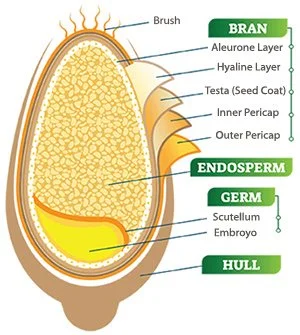
A wheat kernel is made up of three major parts: the bran, the endosperm, and the germ. When the kernel of wheat is milled, all parts of it are crushed into powder, resulting in whole wheat flour. While this is the most nutrient dense flour available, it’s not always practical to make certain foods, and has an unfair reputation for being unpalatable. And where industrialization of flour and food is concerned, whole wheat flour doesn’t have a very long shelf life. For these reasons, all purpose flour has become the most popular flour to make, buy and use. For this flour, the bran and the germ have been removed. The bran is removed mostly because it is a physically hard substance, cutting through strands of gluten in doughs and mixes, leading to a denser final product. But the germ is removed because it is rich in fatty acids and essential nutrients which cause a diminished shelf life. The resulting powder left from this sifting is the kernel’s endosperm which is made in majority of starch, but also some oils and protein. All of this is to say that all purpose flour is not only easier to use on a variety of products (hence the name) but it also has a longer shelf life than a nutrient-diverse whole grain flour.